


SpaceX rings the bell, Musk is the first adult “Mr. Trillion Dollar”. 400 employees have a net worth of over 100 million
Source丨Tencent Technology
Text丨Su Yang
Editor丨Xu Qingyang
On June 12, local time in the US, SpaceX officially landed on the NASDAQ and traded simultaneously with the NASDAQ Texas market in select markets around the world. The stock code is “SPCX”.
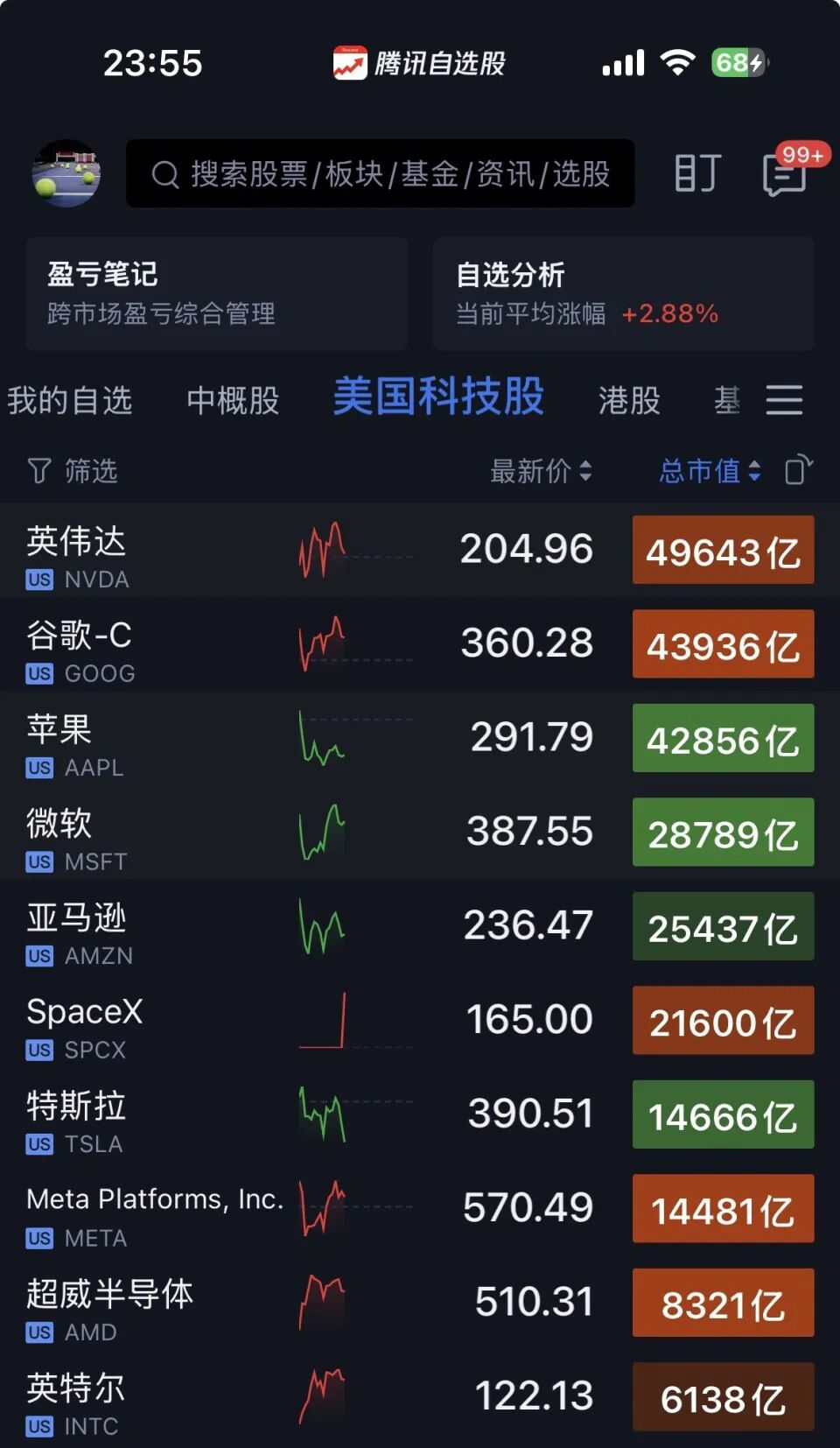
At around 23:50 Beijing time on June 12, SpaceX officially began trading. The opening price was 150 US dollars per share, up 11.11% from the issue price of 135 US dollars, and the market capitalization reached 1.97 trillion US dollars. After opening, it broke 160 US dollars, and the market capitalization exceeded 2 trillion US dollars, ranking sixth in the world, after Nvidia, Alphabet, Apple, Microsoft, and Amazon.
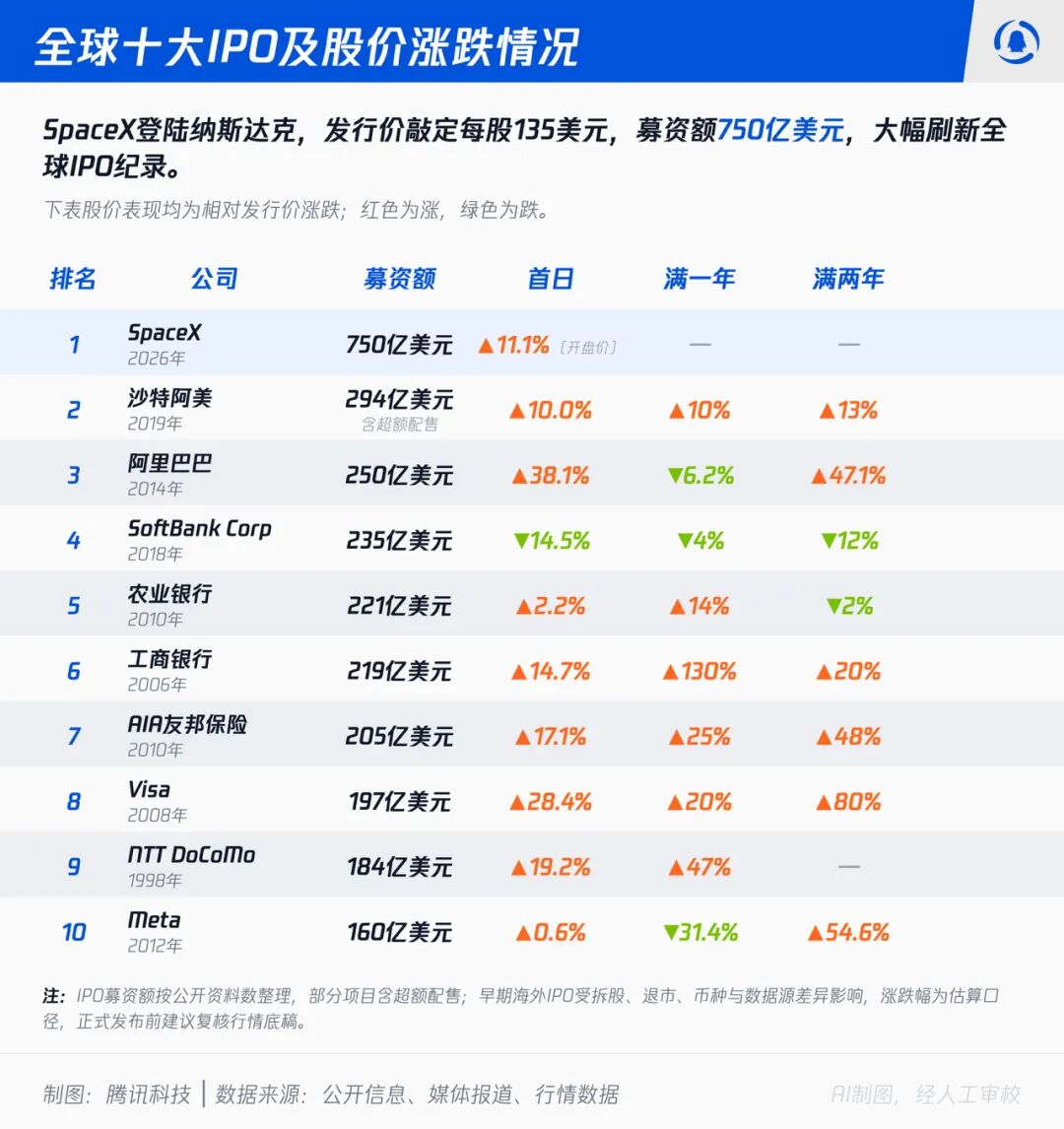
Just the day before, SpaceX officially announced the issuance of 555.6 million shares at US$135 per share, raising US$75 billion, which is more than double the amount of US$29.4 billion raised by Saudi Aramco in 2019, setting the record for the largest IPO in world history.
Based on the issue price, SpaceX's market value is about 1.77 trillion US dollars; if employee stock options and restricted stock units are included, the fully diluted valuation is close to 1.8 trillion US dollars. The underwriter was also granted over-allotment rights for a period of 30 days, and can purchase up to 83.3 million additional shares. If the full amount is exercised, the total size of this transaction will rise to a maximum of about US$86 billion.
At the roadshow stage, the market's enthusiasm for SpaceX far exceeded expectations.
Investors' subscription demand surpassed 250 billion US dollars and recorded nearly four times more oversubscription; retail orders alone exceeded 100 billion US dollars, far exceeding the 20% allotment share reserved for them.
The other side of this capital feast is a rare form of collective wealth: more than 4,400 active and former employees became millionaires by holding company shares, and about 400 of them surpassed $100 million in book wealth. From frontline workers at the launch site to core engineers, SpaceX used this IPO to respond to all the questions the outside world had about the startup 12 years ago.
But beyond the rising market sentiment, disputes and differences are just as sharp.
Well-known shorting investor Jim Chanos publicly criticized the IPO as “a carnival built on hopes and dreams”; the fair value assessment given by Morningstar was only 63 US dollars per share, which is more than 50% off the issue price, which directly contradicts market fanaticism.
01 “We can still fail”
On the day of the stock listing, Musk appeared on NASDAQ and delivered a brief speech.
“I initially expected SpaceX to have less than 10% chance of success,” he said in his speech. “I've told people that even with good luck, we can still fail, but we have to try. If we don't do it, without new companies entering the space sector, humans will never be able to become a true space civilization. Other aerospace companies have built good rockets, but they've never really sought the technology necessary to make life a multi-planetary species.”
He summed up SpaceX's ultimate goal in one sentence: “Make Star Trek a reality, remove 'fantasy' from 'sci-fi', and create an exciting future for everyone.”
“We want to take anyone we want to go to the Moon, Mars, anywhere in the solar system, and maybe one day surpass the solar system. Whoever you are, no matter where you're watching, SpaceX wants to take you to the Moon, take you to Mars, and eventually go further.” He said, “I'm very confident right now that with this team, we will make it all happen for you.”
Finally, he added, “There are always problems that need to be solved on Earth, and we should solve them too. But there must also be something that makes you excited about the future and makes you look forward to when you wake up early in the morning. This is the future SpaceX wants to bring to you.”
The speech provided an emotional coordinate for SpaceX's trillion-dollar valuation. In the next roadshow, management will need to use financial data and business logic to translate this grand narrative into a language investors can calculate.
02 The two types of buyers behind 100 billion orders
However, in this IPO, the participation of another group of people made this capital feast show different characteristics from typical institutions leading the listing. They don't look at Morningstar's valuation model, and they don't care about short sellers' warnings — they're betting on Musk.
Musk posted in 2020: “I am a strong supporter of small retail investors.” At the time, he promised that the SpaceX Starlink IPO would give retail investors “top priority.” Six years later, this promise was fulfilled with a 20% placement ratio.
As for the actual subscription strength of retail investors — orders over $100 billion — it caught underwriters by surprise during the roadshow, and the vast majority of individual investors' order applications were not satisfied.
Anna Watts (Anna Watts), a 33-year-old PR manager in New York, was one of the orderers. She bought a few shares two years after Tesla went public in 2010, and witnessed Musk's betting on electric cars to become the richest man in the world. This time, having tasted the sweetness, she even tried to borrow money or even apply for a bank loan to buy SpaceX shares.
In her opinion: “The more you buy, the better. There isn't much to say when investing in one of the most ambitious companies of all time.”
Craig Stephens, founder of “Access IPos,” an IPO podcast for retail investors, observed that retail buyers are creating “extraordinary demand,” and this demand structure may differentiate this IPO from deals that only chase short-term price jumps.
Kim Forrester, chief investment officer of Bokeh Capital Partners, commented: “This is probably the most promising IPO. Buyers want to be part of the future.”
On the institutional side, SpaceX has received orders from about 1,000 institutions, and each large institution, including sovereign wealth funds, has been allocated more than 1 billion US dollars. The Saudi Public Investment Fund and the Kuwait Investment Authority have already placed impressive orders, and the Qatar Investment Authority may also make significant promises. International orders account for less than 10%, and the Japanese market allocation was raised from US$2 billion to US$2.5 billion.
Furthermore, Ark Investments' founder Kathy Wood (Sister Mu Tou)'s bet is about to be verified. Her venture fund first opened a position at the end of 2023 when SpaceX's valuation fell below $200 billion, and continued to grow in 2025.
In a recent live broadcast, Sister Mu Tou called this IPO a “once-in-a-lifetime investment opportunity.”
Note that the SpaceX listing is also seen as a prelude to the subsequent IPOs of Anthropic and OpenAI. Together, the three may increase the market value of the US Exchange by 3.6 trillion US dollars.
Anthony Sagrim, chief market strategist at Ameriprise, said, “As a prelude to the launch of Anthropic and OpenAI, this is a major event. Even if we see more fluctuations, the demand for AI is still very strong.”
03 More than 400 employees become billionaires
At $135 per share, Musk's SpaceX shares (including options) are worth $688 billion. According to the Bloomberg Billionaires Index, his net worth will increase by about 275 billion US dollars as a result, to about 970 billion US dollars, which is only one step away from being a trillion-dollar billionaire.
The source of this increase of 275 billion US dollars is: Musk already held a large number of shares in SpaceX before the IPO, and was previously included in his net assets according to the private equity market valuation; the current listing switched the private equity valuation to an open market price of 135 US dollars per share, and the spread portion brought about an increase in book wealth of about 275 billion US dollars.
In addition to Musk and early institutional investors, the real beneficiaries of this capital feast include current and former SpaceX employees. SpaceX currently has around 22,000 employees.
According to an analysis by the San Francisco investment platform Hill.com, more than 4,400 people will become millionaires in this IPO, and about 400 of them are expected to gain a fortune of $100 million or more.
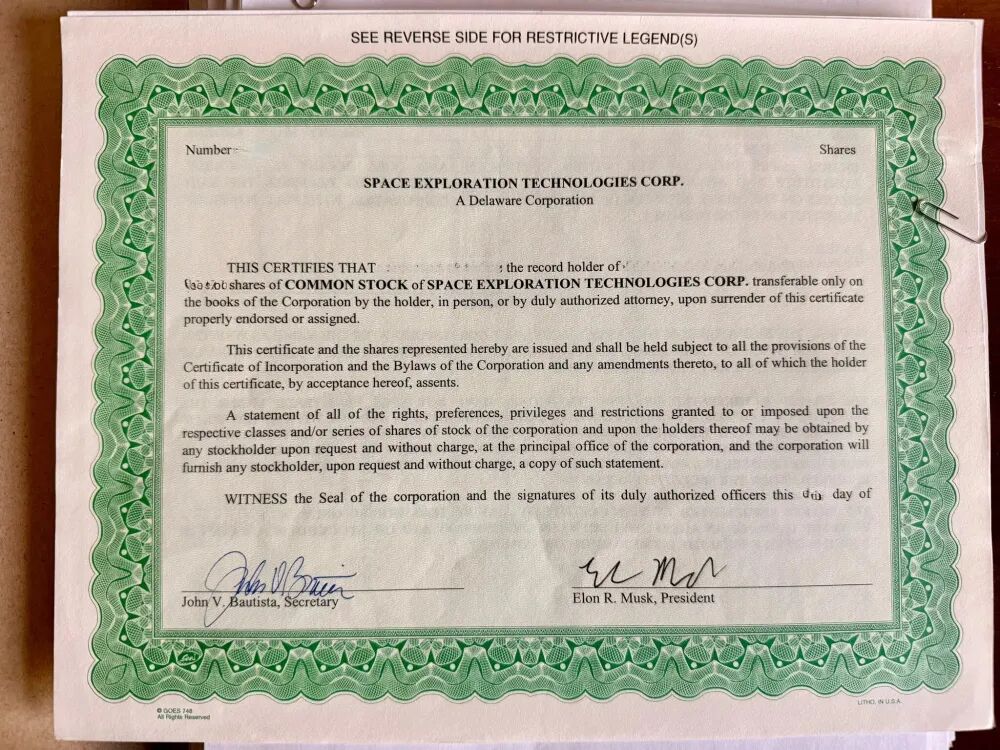
SpaceX stock certificate
Hill.com founder Andrew Benson said, “For most IPOs, you usually only see the founder become a billionaire. It is unusual for 400 people to reach the $100 million threshold. It shows that huge wealth is being created here.”
Trevor Hayes, a 37-year-old former launch engineer, refused a stable job at General Electric after graduating in 2011 and stayed full time at SpaceX for 12 years, holding more than 100,000 shares worth at least US$13.5 million. Hyde claims to be semi-retired. He has also hired a financial planner and set up a foundation where he plans to donate some of his wealth.
According to financial documents, SpaceX placed restrictions on employees selling shares after the IPO.
Even if you become a millionaire on the books, you can't immediately cash out all of your shares on the first day of listing. These sales restrictions usually have a lockdown period, and some employees have to wait months or even years before the ban is completely lifted. This arrangement objectively prevents large-scale employee sell-offs and has a certain effect on stabilizing stock prices.
04 Roadshow stories and undercards at the dinner table
Before the stock was officially listed and traded, SpaceX management conducted a key roadshow to explain the company's growth logic to the market and try to support the $1.77 trillion valuation.
SpaceX President Gwen Shortwell and Chief Financial Officer Brett Johnson held a luncheon with about 300 institutional investors at Morgan Stanley's Midtown Manhattan headquarters. The meeting was hosted by Morgan Stanley Co-President Dan Sinkowitz.
Musk himself, who rarely participated in the roadshow, also briefly appeared at some Zoom investor meetings.
During the roadshow, the Nasdaq Composite Index experienced its biggest one-day decline in more than a year, and Bitcoin retreated 37% from its January high. Some analysts speculate that one reason for the market pullback is that investors are selling off other assets to participate in this IPO. If this speculation holds true, SpaceX's fund-raising effect would have surpassed the company itself and had a siphon effect on market capital flows.
In the roadshow, Johnson summarized SpaceX's growth logic as a “flywheel,” a collaborative system based on Starlink, orbital computation, ground-based AI computing power, and self-developed chip manufacturing.
Among them, Falcon 9's reusable use has reduced industry costs by 85%, and Starship's goal is to increase cost efficiency by another 10 times. The Starship V3 has a low-Earth orbital capacity of 100 tons, and the fourth edition is expected to double to 200 tons. This cost advantage directly translates into competitive barriers for other businesses.
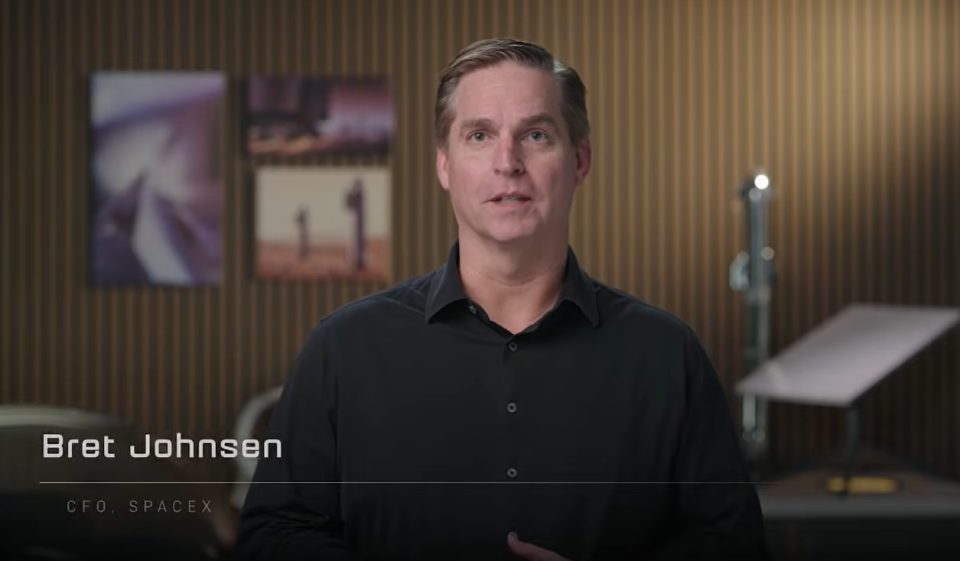
SpaceX CFO Brett Johnson
Starlink currently has more than 9,600 satellites in orbit, accounting for 75% of the world's mobile satellites. SpaceX is transitioning from V2 satellites to v3. The latter has a capacity of about 1 Tbps. Each starship can carry 60 satellites per launch, achieving 61 Tbps of downlink capability. According to Johnson, with only 20 Starship launches, the Starlink Network can add 1.2 PB of transmission capacity every year.
Once this level is reached, Starlink will no longer be a backup option for remote regions, but an important part of global internet traffic.
SpaceX also emphasized the future of the AI business during the roadshow, claiming that its AI products face a $23 trillion market opportunity, and emphasized that it is the only company that can build AI computing power in space.
To prove the viability of monetizing AI infrastructure, Johnson mentioned two recent collaborations: SpaceX signed an agreement with Anthropic to allow each other to access and host models at SpaceX data centers; and an agreement was reached with Cursor to use its own computing resources to improve coding capabilities. “We are moving along the path of monetization.” he said.
05 The probability of success is only 7%?
There are fundamental differences in the market regarding the valuation of SpaceX.
CNBC host Jim Cramer warned on the eve of the IPO that the biggest risk was not insufficient demand, but too many short-term speculators. “They may not even stay for an afternoon; they just want to cash out as soon as possible.” He believes that the ideal placement would be for the shares to fall into the hands of long-term holders.
Jim Chanos, a well-known short seller and founder of Chanos & Company, called SpaceX “an IPO of hopes and dreams.” “The space market is almost limitless, and you can make up any story you want — Martian colonies, lunar factories, space data centers — to justify the valuation.”
Michael Barry, the “big short man” famous for predicting the 2008 financial crisis, previously wrote: “There is nothing in SpaceX's listing application documents indicating that it is worth $1 trillion, let alone $2 trillion.” He believes any rise after the IPO will be “based on hype and technology.”
Ross Gerber, CEO of Gerber Kawasaki, who holds SpaceX shares, also questioned: “Investors are paying a very high premium for this stock.” The current valuation is more than four times higher than the $400 billion valuation 13 months ago.
Morningstar gave a fair value of only $63 per share, a 53% discount on the issue price of $135. Analyst Nicholas Owens constructed three scenarios:
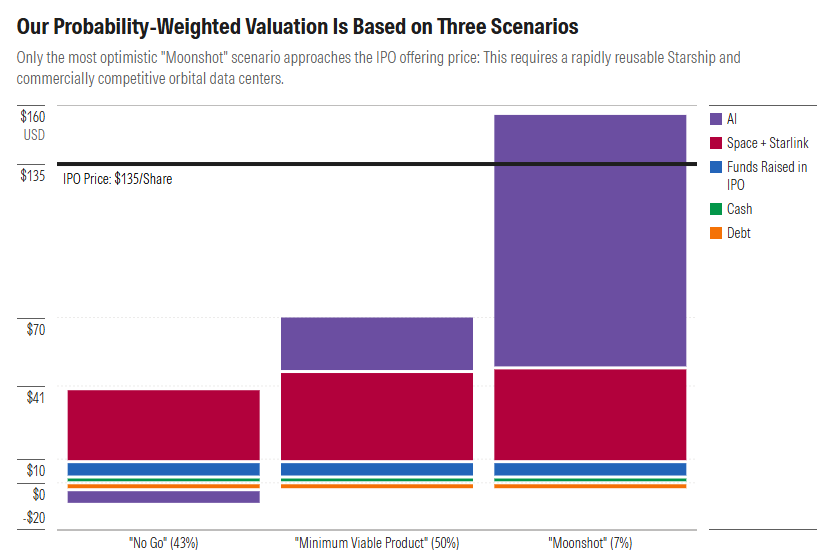
Morningstar believes that only if Starships are rapidly reused and orbital data centers are commercially competitive can SpaceX's stock price be close to the issue price
Under the first scenario, Starship achieved an 85% reuse rate, successfully commercialized the orbital AI data center, and formed a cluster of about 59,000 satellites by 2035, providing 11.6 gigawatts of AI computing power, with annual revenue of 225 billion US dollars. In this scenario, SpaceX is worth $154 per share, which is 14% higher than the issue price.
Morningstar believes that even so, the probability of this scenario being realized is only 7%.
The second scenario has a 50% chance of being realized: the orbital data center is partially feasible. By 2035, a cluster of about 48,000 satellites will be formed, providing 2.4 gigawatts of computing power, and an annual revenue of 47 billion US dollars.
The third scenario has a 43% chance of happening: the rail data center is not working, and the company may abandon the project around 2028, just as Musk abandoned plans to build multiple small factories at Tesla back then.
Morningstar wrote in the report: “Based on the issue price of $135, investors are required to pay an additional $72 'option premium' per share to obtain the right to participate in a long list of projects SpaceX may carry out in the future.”
In other words, the premium paid by the market is betting on the story Musk will tell next.
In an exclusive interview with J.P. Morgan recently, Musk summed up the reason for the listing in one sentence: SpaceX is moving from a stage of self-sufficiency to a new growth cycle requiring huge capital investment.
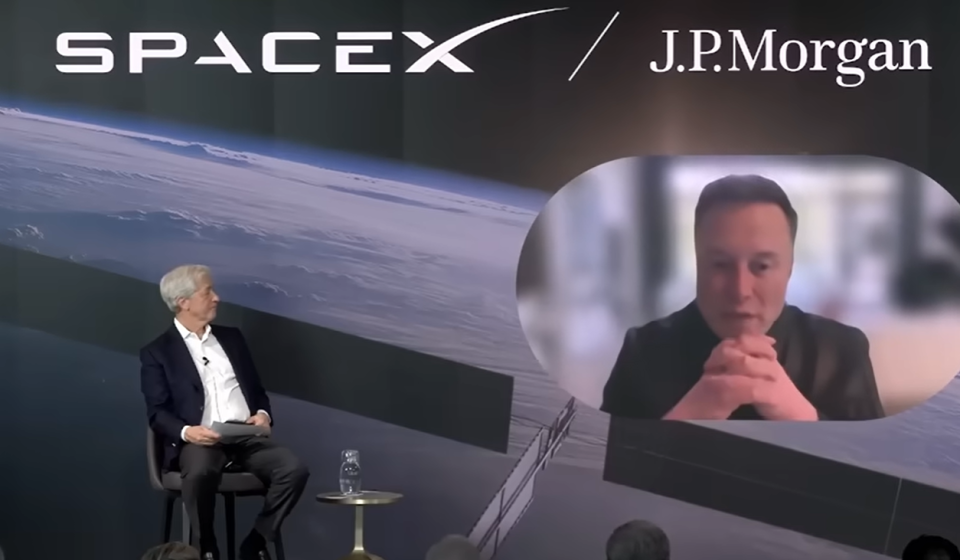
SpaceX CEO Musk interviewed
“We've probably been supplying our own blood since 2014 and 2015. The private equity round is actually a liquidity arrangement for employees and investors,” he explained. “But now it's different. We will launch approximately 100,000 satellites into orbit for communication purposes only.” The capacity of this batch of V3 satellites is 10 to 20 times that of the current V2. The SpaceX chip design team has completed the streaming of three special chips for this purpose. The bandwidth will be 100 times higher than the existing Starlink system, and the delay will be reduced by half.
In addition, Musk also explained the logic of space data center construction — it is increasingly difficult to get approval to build power plants on the ground, and the solar energy that can be captured in space is 1 million times what the Earth's economy needs, and it is still far less than one-millionth of the output of solar energy. “We are starting a huge new phase of growth, for which we need more capital.”
“We'll know in two to three years if Starships are reusable or if GPU racks in space are viable. But the company requires everyone to decide on Friday if this is possible and how much it's worth.” Owens, host of the interview, concluded.
Investors who bought this stock for $135 are betting on Starlink's cash flow, Falcon rocket launch orders, and execution of an extremely risky option — whether Starship can be reused as scheduled, whether orbital AI computing power can be commercialized, and whether the market remains patient while waiting for answers.
Twitter:https://twitter.com/BitpushNewsCN
Compare the TG exchange group:https://t.me/BitPushCommunity
Compare TG subscriptions:https://t.me/bitpush
