


Goldman Sachs spent $2.25 billion, and crypto followed the trend
Goldman Sachs is entering the ETF market again.
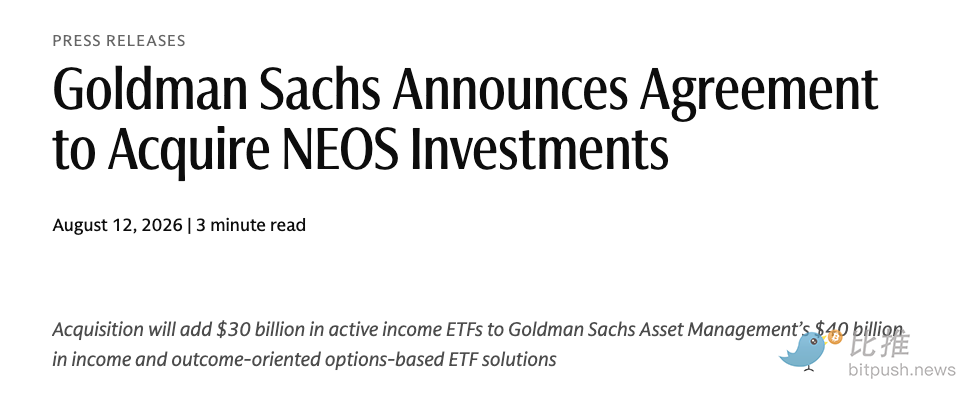
On August 12, Goldman Sachs announced that it had reached an acquisition agreement with asset management company NEOS Investments, with a transaction consideration of up to US$2.25 billion, paid in cash and shares, and linked to some performance and service commitments. Currently, the transaction has not been completed, and regular conditions such as regulatory approval are still required. Delivery is expected in the first quarter of 2027.
Because NEOS has three Bitcoin and Ethereum-related ETFs, the deal was quickly labeled “Goldman Sachs adds encryption.”
But if you take a look at NEOS's asset composition, you'll find that crypto is actually only a small part of this deal.
What Goldman Sachs really wants to buy is NEOS' ability in active ETFs, especially in options income strategies.
Of $30 billion in assets, crypto accounts for only about 4%
NEOS was founded in 2022 and currently manages approximately US$30 billion in assets, and has 19 option-type income ETFs. Its core strategy is uncomplicated: it superimposes options on top of asset exposures such as stock indices, bonds, gold, and Bitcoin, and earns additional income by charging option fees.
What really supports the scale of NEOS is not Crypto either.
As of August 11, its two largest products — the S&P 500 High Income ETF (SPYI) and the Nasdaq-100 High Income ETF (QQQI) — had assets of about US$11.36 billion and US$13.87 billion respectively, totaling more than US$25.2 billion, accounting for more than 80% of NEOS's total size.
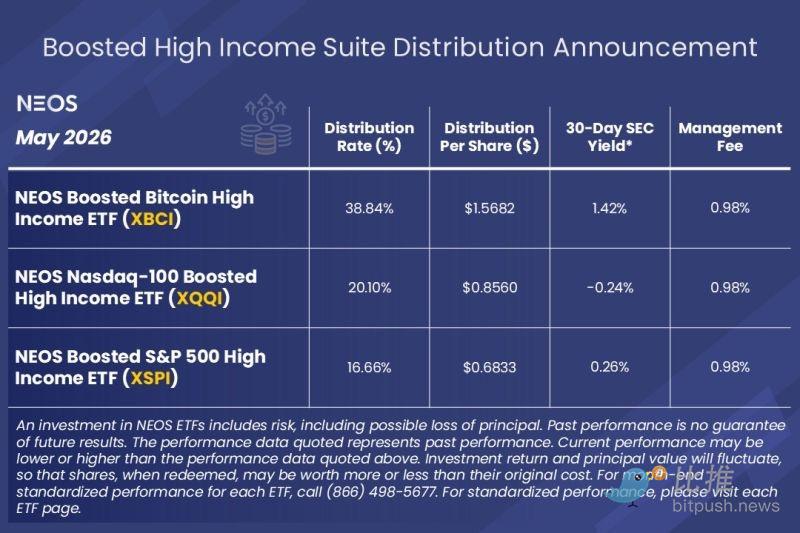
In contrast, the net assets of the three crypto-related products BTCI, XBCI, and NEHI are about US$1.1 billion, US$111 million, and US$77.67 million respectively, totaling about US$1.29 billion, which is only about 4% of NEOS's total assets.
So, this is not a “Goldman Sachs spent $2.25 billion to buy a crypto ETF” transaction, let alone $2.25 billion about to flow into Bitcoin and Ethereum.
If the deal is finally completed, these three products will enter Goldman Sachs Asset Management's product portfolio, but they are more like a puzzle piece of NEOS's many strategies.
What I'm really interested in is the active ETF business
Why is Goldman Sachs willing to pay up to $2.25 billion for a four-year old ETF company?
The core is growth and the ability to charge fees.
According to Morningstar data, the current asset size of global derivatives yield ETFs has reached about 180 billion US dollars, with a compound annual growth rate of more than 70% since 2021, making it one of the fastest growing categories in the ETF market.
This type of product also has a real appeal for asset management companies: the rates are much higher than traditional index ETFs.
Currently, many ordinary S&P 500 ETFs have reduced their rates to a few basis points, while NEOS' two largest funds, SPYI and QQQI, have management fees of 0.68%. According to estimates, these two products account for more than 80% of NEOS's assets and may contribute about 200 million US dollars in revenue each year.
This is the key that Goldman Sachs is willing to pay a high price.
Goldman Sachs has been expanding its asset and wealth management business over the years, hoping to increase more stable management fee income and reduce its dependence on cyclical businesses such as investment banking, mergers and acquisitions, and transactions. In the second quarter of this year, the net revenue of Goldman Sachs's asset and wealth management business was 4.6 billion US dollars, an increase of 20% over the previous year. Jefferies analysts believe that the acquisition of NEOS not only seizes the trend of accelerating the popularity of derivative yield ETFs, but also further increases Goldman Sachs's more sustainable asset management revenue.
And NEOS isn't an isolated deal.
Earlier this year, Goldman Sachs completed the $2 billion acquisition of Innovator Capital Management, which also focuses on options and buffer ETFs. Successive moves are clearly complementing active ETFs, yield strategies, and risk management product lines rather than a sudden shift to betting on cryptocurrencies.
After the transaction is completed, Goldman Sachs's active ETF scale is expected to reach about 80 billion US dollars, and the entire global ETF platform will reach about 130 billion US dollars, and rank among the top eight active ETF management agencies in the US.
Three crypto ETFs are still worth watching
Currently, the price of Bitcoin is about $63,500, and Ethereum is about $1,625, which has clearly declined from previous highs.
In a bull market, what investors are most concerned about is how much the price will rise; however, after entering a phase of high volatility, shock, or even decline, “whether revenue can be obtained from the fluctuation itself” becomes attractive.
For example, NEOS' BTCI will gain price exposure through Bitcoin ETP, and at the same time, combine a bullish option strategy to try to turn Bitcoin's high volatility into monthly income.
But it's also easy to misunderstand here.
By the end of July, BTCI showed a distribution ratio of 26.73%, XBCI reached 40.84%, and NEHI reached 32.93%; however, their 30-day SEC revenue for the same period was only about 1.5% — 1.6%. BTCI's total return for the past year up to the end of June was -40.95%.
In other words, a high allocation ratio does not equal a high return on investment. Option income can cushion some of the fluctuations, but it cannot eliminate the decline in currency prices, let alone mean a steady income of 20 to 30 percentage points every year.
Instead, this shows the true value of these three products to Goldman Sachs: instead of betting on an immediate surge in BTC or ETH, packaging crypto assets into a more mature wealth management tool — some want to do the right thing, some want to get cash flow, and others want to manage fluctuations, they can all find corresponding products.

What signals did this deal really send?
In the short term, its direct impact on BTC and ETH prices is limited.
$2.25 billion is the highest transaction consideration paid by Goldman Sachs for NEOS shares; it is not the capital to buy crypto assets; the three Crypto ETFs also currently only account for a small portion of NEOS assets.
But over a longer period of time, it still makes sense.
Over the past few years, Wall Street's solution was “how to make it easy for customers to buy Bitcoin”; what is now beginning to be solved is “how to design yield, options, and risk management products around Bitcoin.”
This shows that crypto assets are being further incorporated into traditional wealth management systems.
Therefore, Goldman Sachs plans to acquire NEOS. The main line is active ETF, and encryption is only a card that will enter Goldman Sachs's map incidentally.
However, it is this card that shows that when large asset management institutions began to not only discuss “whether Bitcoin will rise or not,” but to study how to continuously develop products, manage risks, and collect management fees around it, Crypto's role on Wall Street is no longer the same as it was a few years ago.
Author: Little Bear Cookies
Twitter:https://twitter.com/BitpushNewsCN
Compare the TG exchange group:https://t.me/BitPushCommunity
Compare TG subscriptions:https://t.me/bitpush
