


From 0 to 2.6 billion US dollars, the one that bought BlackRock BUIDL is not Wall Street
Source: Tiger Research
Authors: Henry Kim, Ryan Yoon
Compiled and organized by: bitPushNews
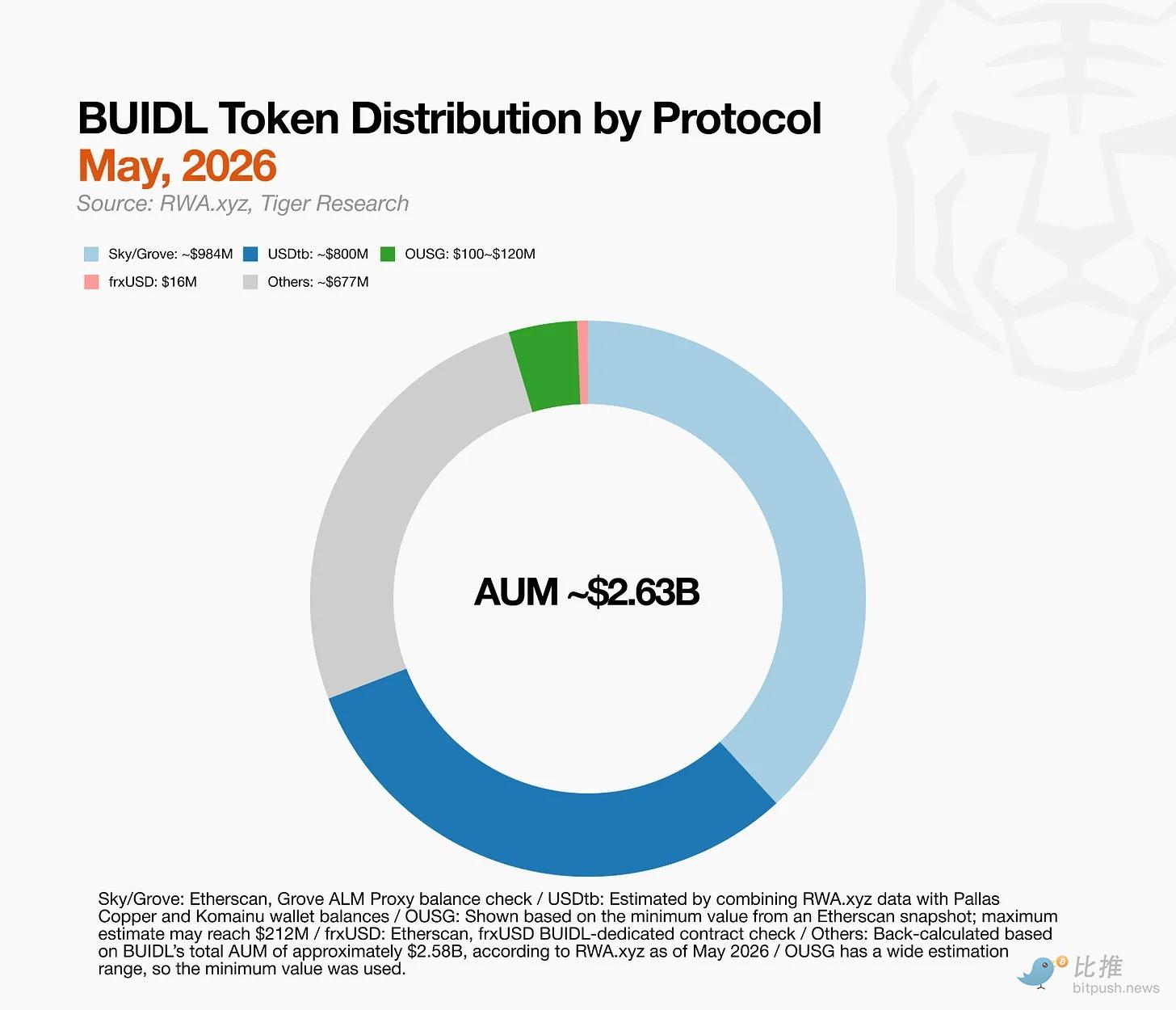
BlackRock(BlackRock)'s BUIDL has become an indispensable asset in the digital asset sector. However, its biggest buyers are not traditional institutions, but DeFi (decentralized finance).
Core summary
The on-chain significance of BUIDL is not that BlackRock has issued a token, butEthena、Ondo, Frax, and Spark used BUIDL as a building block (building block) for their dollar products, turning an institutional fund into a fundamental asset in the DeFi supply chain.
The agreement chose BUIDL not for yield, but because it simultaneously satisfies three conditions: clear legal claims, on-chain composability, and existing compliance. No other asset can provide all three at the same time.
The supply chain doesn't stop at the first tier. As BUIDL is processed into USDTB and further transformed into dollar products for specific ecosystems, demand for underlying assets grows with each new ecosystem.
BUIDL has revealed a new tokenized asset distribution channel. Its customers aren't found through traditional sales channels, but through DeFi protocols — a customer group that doesn't exist in traditional finance. If this channel is not recognized, the next BUIDL will not appear.
From institutional products to protocol infrastructure
BUIDL was originally designed for institutions: providing cash and US Treasury exposure, eligible investors only, and a minimum subscription amount of $5 million.
However, the first actors were DeFi protocols rather than traditional institutions. They didn't buy just for profit, but for the following three reasons:
Legal Clarity: Issued under Rule 506 (c), investors' rights are protected by US securities laws. Agreements can clearly explain asset attributes and redemption processes in legal terms.
Lower compliance costs: After the GENIUS Act, reserve design became very complicated. BUIDL already complies with institutional-level collateral standards. The burden of compliance is transferred, and there is no need to build from scratch. As regulations are tightened, this advantage is becoming more obvious.
On-chain composability: Can be used as protocol reserves, exchange collateral, or the bottom layer for ecosystem dollar products.
Since no other asset at the time could satisfy these three points at the same time, BUIDL became the default base asset.
How DeFi protocols use BUIDL
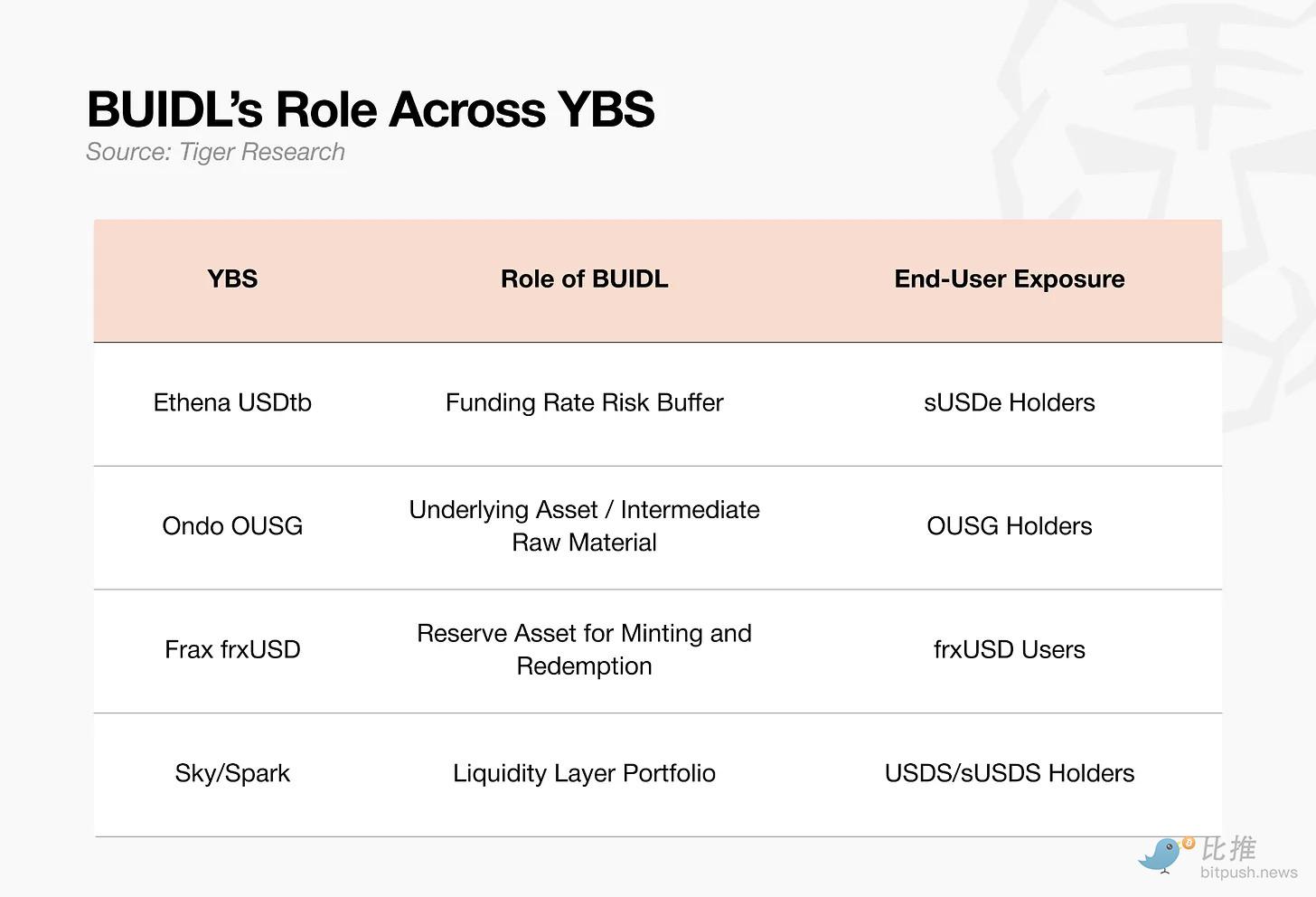
The point is not the fact that the agreement holds BUIDL, but rather the specific role that BUIDL plays in each protocol's architecture.
2.1. Ethena (USDTB): Funding Rate Buffer
Ethena's flagship product is synthetic dollar USdE and its staked version susDE.
USdE's revenue sources include:
Staking rewards for collateral assets
Funding rates for perpetual contracts (via the Delta-neutral strategy)
The second source of revenue — the funding rate — comes from the Delta neutral strategy. USdE holds short futures positions equal in size to collateral to offset price risk. When demand from the bulls dominates, the bulls pay capital fees to the bears. Ethena, as the bear side, directly collects this portion of revenue.
The risk occurs when the funding rate turns negative. In a bear market, demand from bears may exceed that of bulls, causing bears to pay capital fees. For Ethena, revenue became cost. If this continues, insurance funds will dry up, and USDe's dollar pegs will come under pressure.
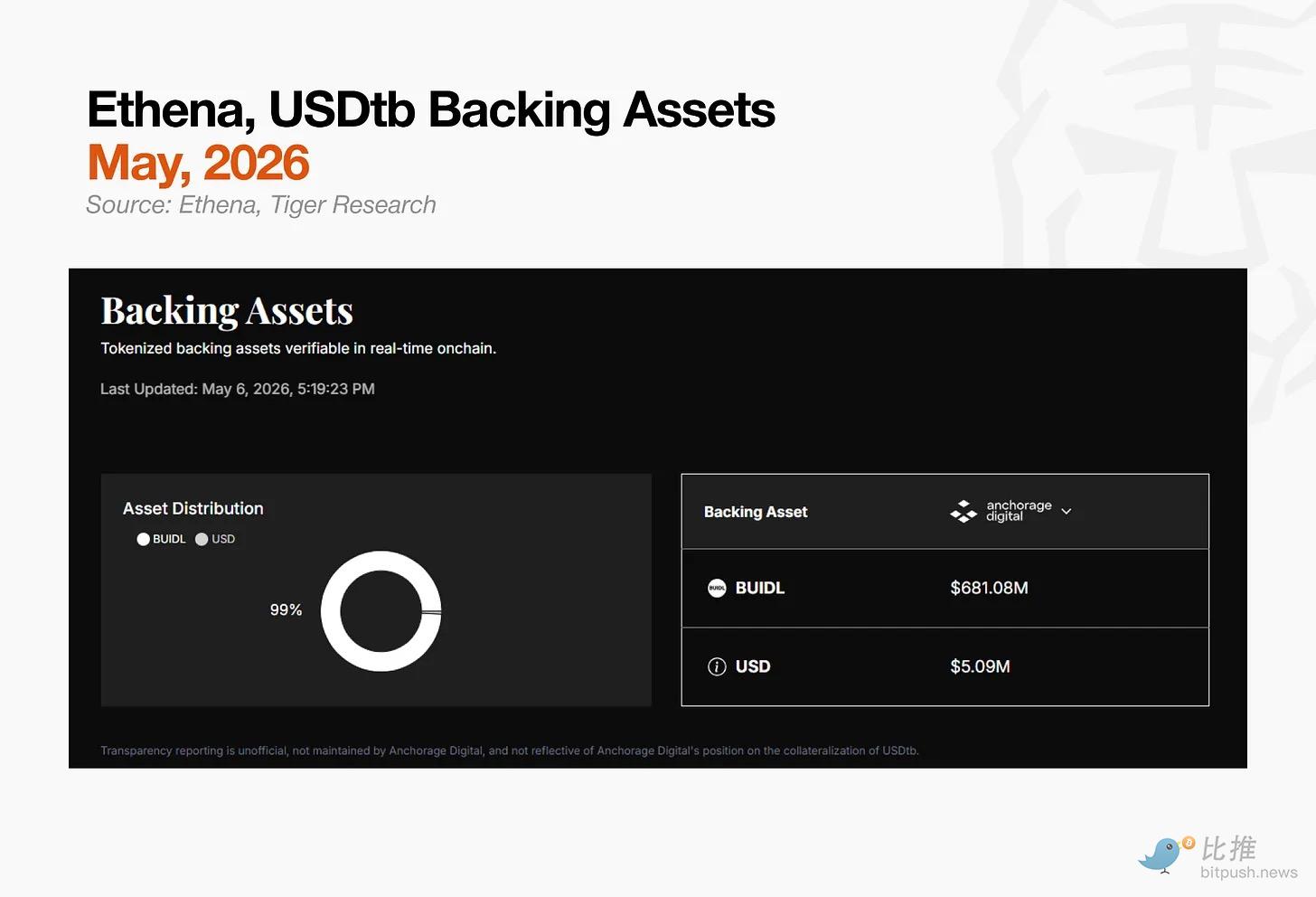
Ethena needed an asset that could absorb that pressure. USdTB filled this role, with core reserves of BUIDL and USDC. The purpose is not to increase earnings, but rather as a defensive buffer to ensure Ethena's overall structural stability during periods of negative funding rates.
2.2. Ondo (OUSG): BUIDL as intermediate input
OUSG (Ondo US Treasury Bond Fund) is a tokenized fund that brings institutional-grade US debt exposure to the chain. Direct access to institutional money market funds like BlackRock BUIDL or Franklin Templeton FOBXX usually requires a multi-million dollar threshold and qualified investor status. OUSG lowered this threshold and acted as an on-chain intermediary, making these assets available to DeFi users.
BUIDL is a core component of OUSG's reserve structure, along with Franklin Templeton's FOBXX and WisdomTree's WTGXX. OUSG repackages institutional assets that are not directly accessible to retail investors into an on-chain intermediate product.
2.3. Frax (frxUSD): Minting and Redemption Reserve
frxUSD is a new dollar stablecoin designed by Frax Protocol with the goal of maintaining a stable value of $1 like USDC or USDT. Its unique feature is the reserve structure.
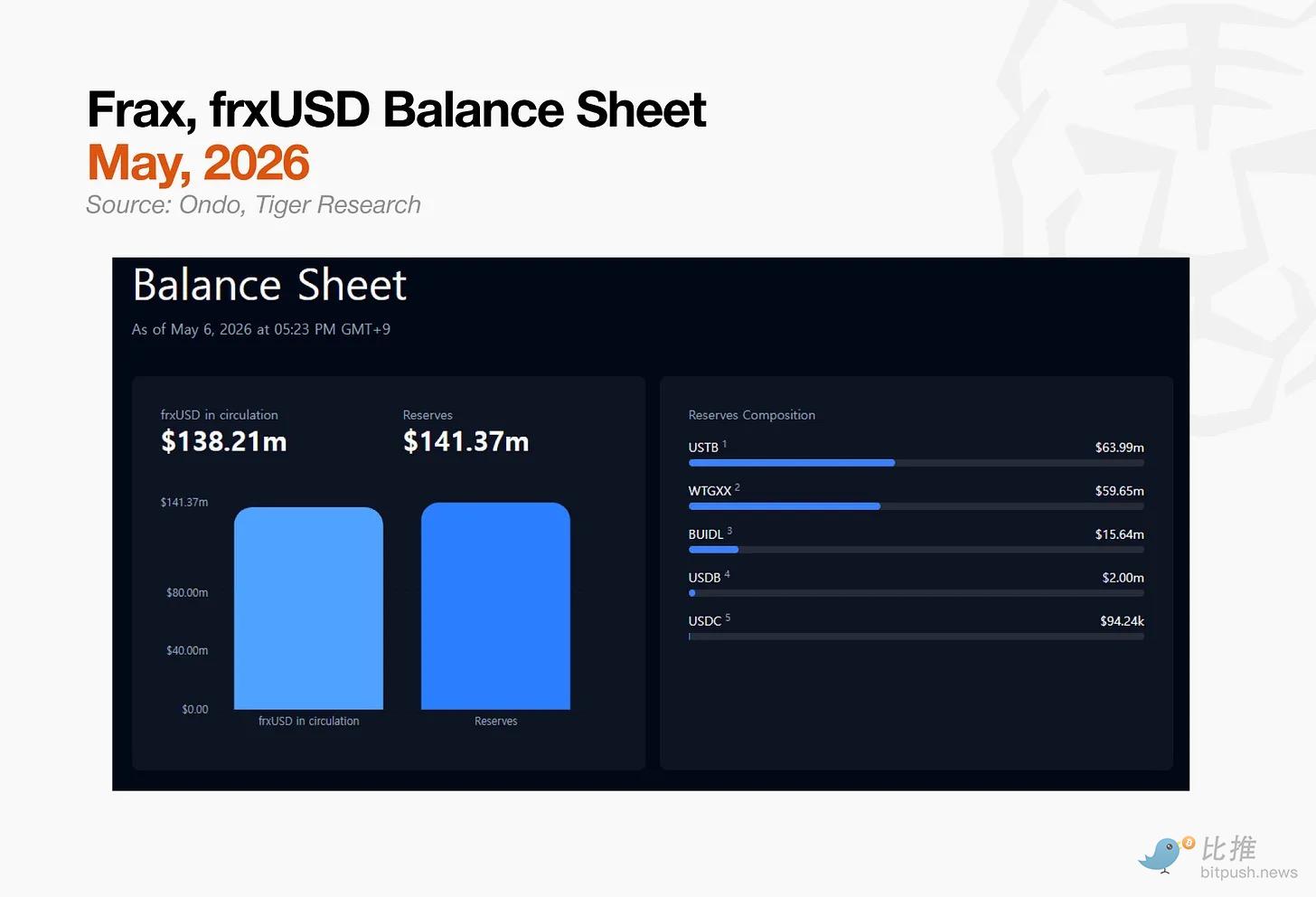
Existing stablecoins usually store their reserves in cash or treasury bonds in offline bank accounts. Frax replaced it with BUIDL (an on-chain tokenized treasury bond). The mechanism is a direct 1:1 exchange: deposit BUIDL to mint frxUSD and return frxUSD to redeem BUIDL.
End users do not directly interact with this structure. They use frxUSD as a stablecoin in payments or DeFi, while BUIDL operates behind the scenes to support every minting and redemption.
2.4. Spark's Tokenized Grand Prix (TGP) allocates a common thread with BUIDL
Spark's “Tokenization Grand Prix (TGP)” allocated $500 million of its $1 billion quota to BUIDL, and the rest to Superstate's USTB and Centrifuge's JTRSY. Instead of choosing a single reserve asset, Spark built a portfolio.
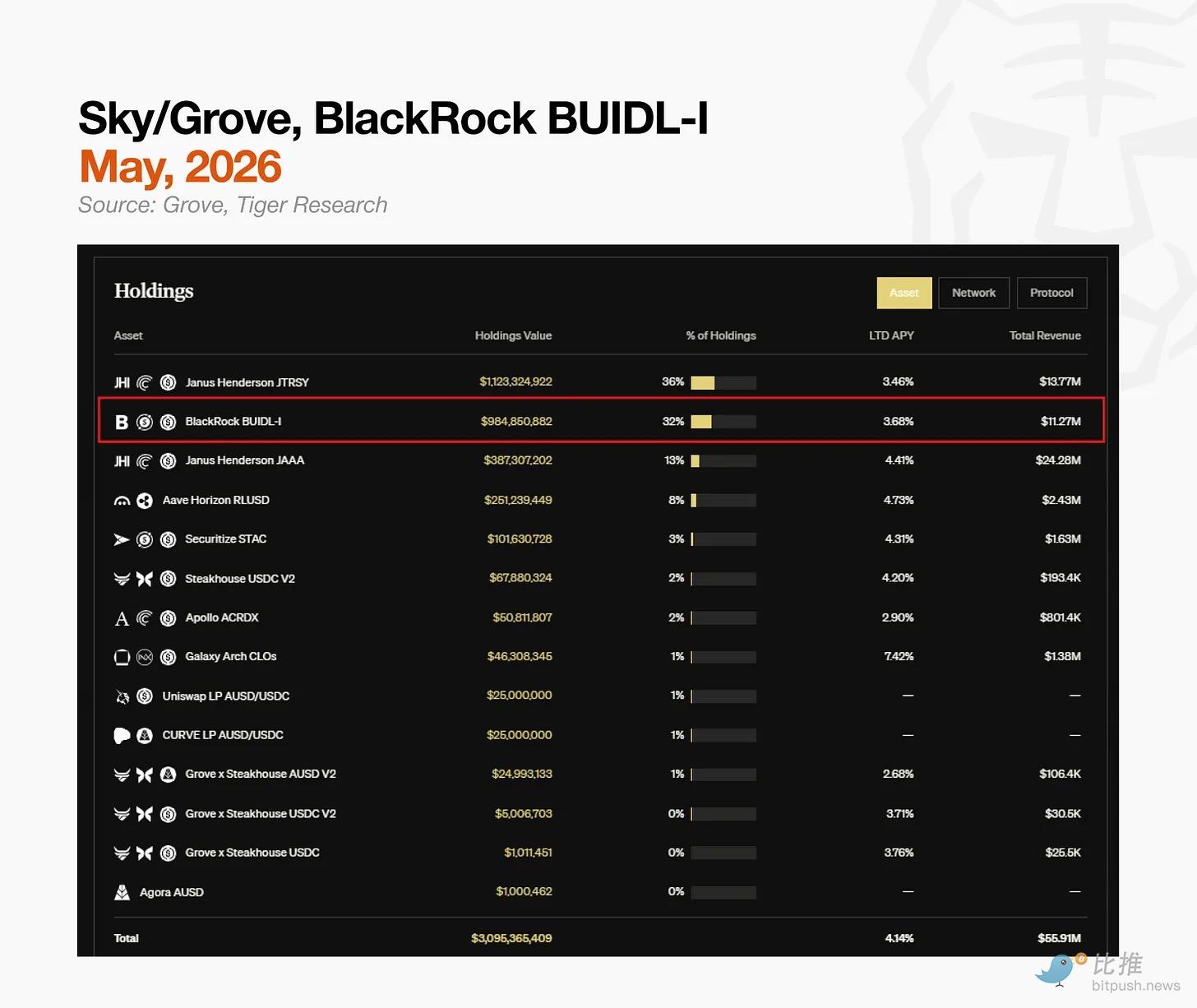
Traditional asset managers also mix treasury bonds, money market funds, and credit instruments in the same way. The difference is that this portfolio runs on-chain and is redeployed as collateral and liquidity through the DeFi track.
In the four cases above, BUIDL played different roles: reserve assets, intermediate inputs, minting and redemption support, and combination components. But there is one common pattern: BUIDL is not the end product under any circumstances. The agreement purchased BUIDL to fill its own system, and this demand structure is already operating on a large scale.
Reprocessing of BUIDL: Composite Requirements Structure
As mentioned earlier, various agreements have directly adopted BUIDL as a reserve asset. But the chain didn't stop there. Products built on BUIDL are becoming reserves for new products, thus enabling an extended layer of derived structures.
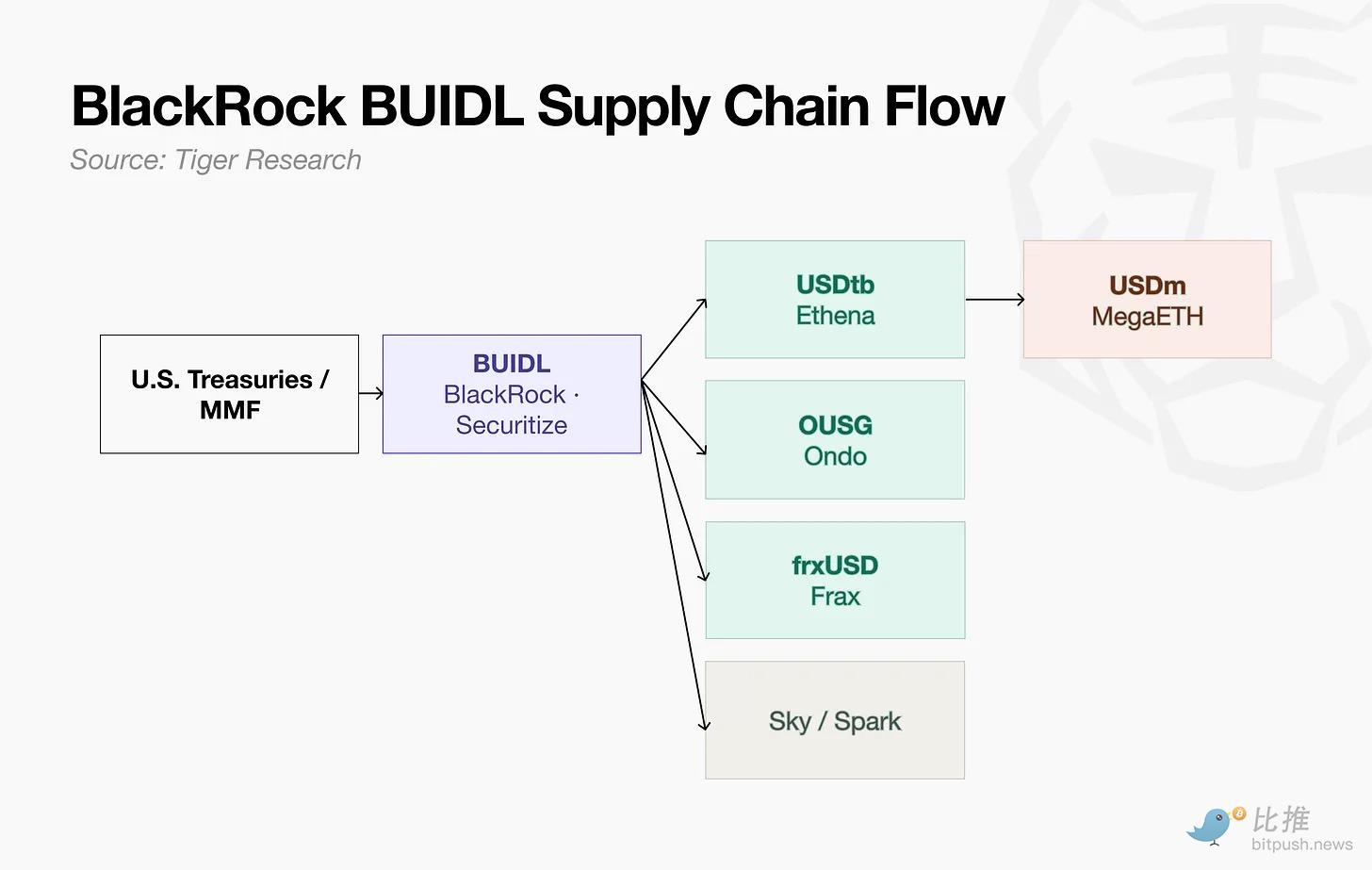
MegaETH's USDM is the clearest example. USDm is an ecosystem specific stablecoin developed by MegaETH in collaboration with Ethena. Its reserve is USDTB, while USDtB's reserve is BUIDL. As demand for USDM within MegaETH grows, so does the demand for BUIDL.
Every new ecosystem that enters this structure adds “customers” rather than “competitors.” In on-chain finance, speed of adoption is also an important differentiator. Building an equivalent derivative structure in traditional finance requires months of regulatory review, legal contract signing, and escrow arrangements. On the chain, this process is significantly compressed. Within the regulatory framework, there is virtually no limit to the scope of eligible underlying assets.
In short, BUIDL is unlocking compound demand by anchoring an ever-expanding on-chain structure to secure real-world assets.
What comes after BUIDL?
BlackRock built an institutional fund; Ethena, Ondo, Frax, and Spark adopted it as the underlying asset; MegaETH superimposed an ecosystem dollar on top of it. This all happened in less than two years since BUIDL launched in March 2024.
This speed isn't just driven by BlackRock's brand. Legal clarity, on-chain composability, and regulatory compliance: BUIDL was the only asset that offered all three at the same time. This first-mover advantage is huge, and has compounding effects as more DeFi protocols incorporate BUIDL into their reserves.
For the team designing the next tokenized asset, the question was how to get into this market. Most people take one of the following two paths: either assume tokenization itself will generate demand, or replicate traditional financial distribution models through sales teams, broker networks, and existing channels.
BUIDL is following the third path. DeFi protocols including Ethena, Ondo, Frax, and Spark are among the first adopters. Exchanges and institutions such as Deribit, Binance, and OKX followed suit. BUIDL has found a customer segment that doesn't exist in traditional finance.
These customers buy assets and build their own products on them, which in turn form the basis for the next agreement. They are not customers acquired through sales, but customers attracted through “design.” Without identifying this customer group, we won't be able to talk about the next BUIDL.
Twitter:https://twitter.com/BitpushNewsCN
Compare the TG exchange group:https://t.me/BitPushCommunity
Compare TG subscriptions:https://t.me/bitpush
